
Cinema 4D Render Farm
Unlock professional motion graphics and 3D production capabilities with our specialized Cinema 4D cloud rendering. Designed for the most demanding CGI pipelines.

Professional Motion Design & 3D
Our farm is built to handle complex Cinema 4D workflows. From abstract motion graphics to high-end architectural visualization, experience the power of distributed rendering.
Built for Demanding Cinema 4D Projects
Whether you are working on complex motion graphics, product visualization, or architectural scenes, our farm provides the high-performance CPU and GPU nodes required for Cinema 4D's advanced rendering engines.
Parallel processing across thousands of nodes for rapid scene output.
Optimized for Redshift, Arnold, Corona, V-Ray and Cinema 4D standard/physical renderers.
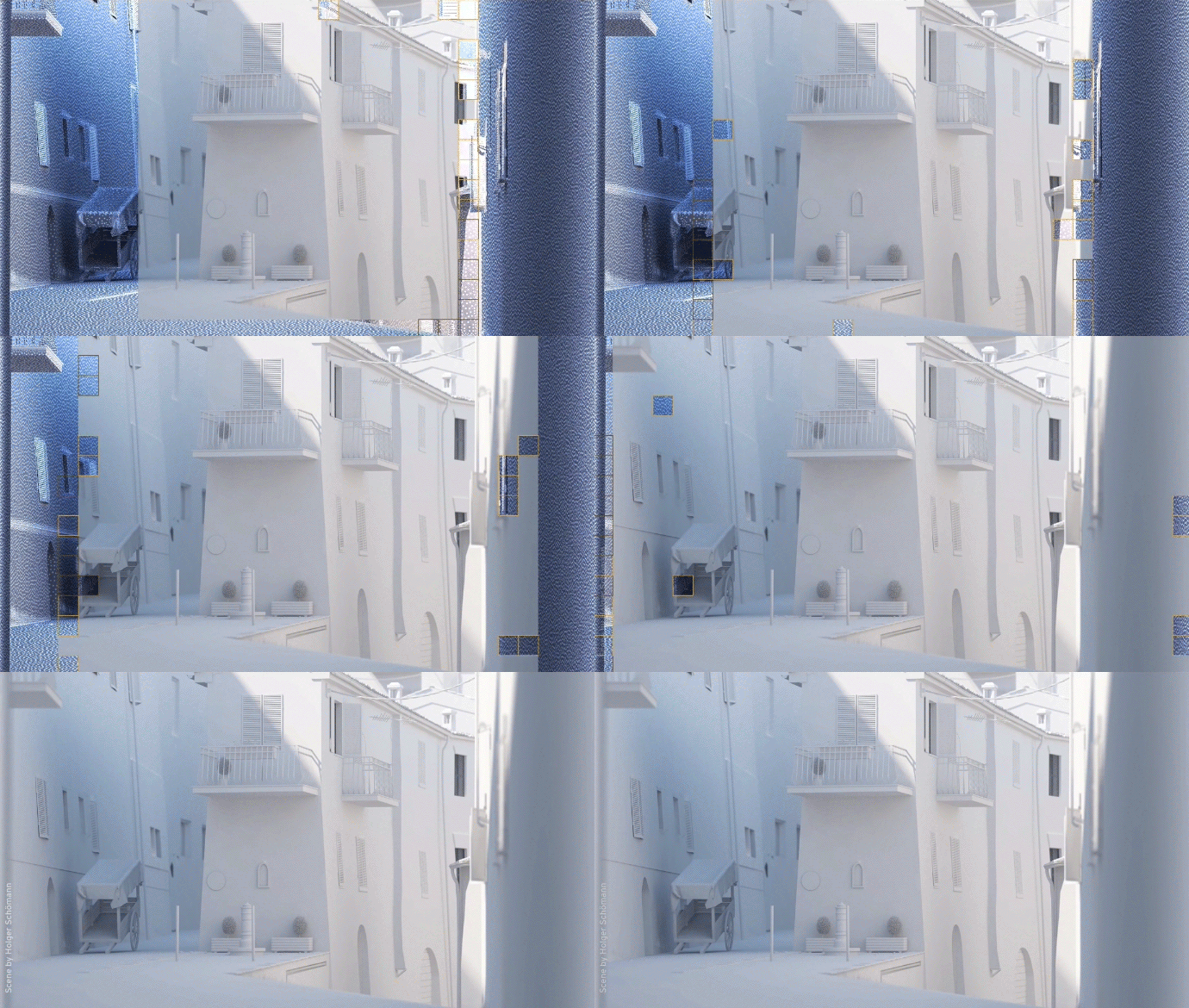

Streamlined Workflow, Faster Rendering
Accelerate your Cinema 4D project delivery with our intelligent pipeline. Batch rendering, automated scene submission, and real-time job monitoring ensure your production stays on track and ahead of schedule.
- Automated scene asset collection
- Batch render queue management
- Real-time job progress tracking
- Fast automated frame downloads
Keep Your Cinema 4D Projects Protected
Your creative assets are protected by our enterprise-grade security protocols. We utilize encrypted data transfers, isolated cloud storage, and secure server environments to maintain complete confidentiality.


Stable Service, Professional Support
Experience maximum reliability with our 24/7 monitored cloud infrastructure. Our dedicated technical support team is always ready to assist you with Cinema 4D scene optimization and render troubleshooting.
Cinema 4D is billed as cloud render: the farm assigns the machines and you pay for the CPU and GPU hours your job uses.
Supported Cinema 4D versions and render engines
The farm loads 3 Cinema 4D versions, from 2024 to 2026. Submit a .c4d scene from SkyRender Desktop and it renders on the same version you authored it in — there is no conversion step and no downgrade, so shaders, modifiers and render settings arrive exactly as you left them.
Cinema 4D versions
- Cinema 4D 2024
- Cinema 4D 2025
- Cinema 4D 2026
Render engines
- Standard
- Physical
- Redshift
- Arnold
- Corona
- V-Ray
SkyRender Desktop checks the scene before it uploads and names anything the farm cannot load, so a mismatch is caught on your machine rather than after you have paid for a node.
How a Cinema 4D job runs
You submit the scene and the farm allocates the machines for it. There is no node list to read and no hardware to choose — the capacity a job needs is worked out from the job, and you are billed for the CPU and GPU hours it actually uses.
1. Upload the scene
SkyRender Desktop packs the .c4d file with its textures, caches and linked assets, and uploads what changed rather than the whole project.
2. The farm allocates the machines
Capacity is assigned to the job rather than rented by you, so there is nothing to size or configure. What you pay follows the CPU and GPU hours the render consumes.
3. Render
Frames are rendered in parallel across the machines assigned to the job, and the running cost updates live while it works rather than arriving as a total at the end.
4. Collect the frames
Finished frames download automatically as they complete, so the first ones are on your disk before the last ones have started.
Because the hardware is assigned rather than chosen, the number to watch is time rather than machines: a heavier scene costs more because it occupies the farm for longer. Send two or three test frames first and the per-frame figure they report is the one the full sequence will follow.
What a Cinema 4D render costs
There is no per-frame price list, because there is no honest one to publish. What a frame costs depends on your scene — how many objects it holds, how the shaders are built, how many light bounces you allow and how long a sample takes to resolve. Two scenes at the same resolution can differ by an order of magnitude.
What we can give you is arithmetic. You pay for node time, billed in SkyPoints, with no subscription and no minimum monthly spend. On a published benchmark of 2,500 frames averaging 60 seconds each on an RTX 4090 in Cycles, the job costs about $27 here, against $240 at Fox Render Farm, $524 at Ranch Computing, $572 at Rebus Farm.
If the estimate matters before you commit, render a handful of frames first. A test render on the real hardware costs a few SkyPoints and tells you the per-frame figure for your scene exactly, which is more useful than any average we could quote.
Your files, and how long we keep them
There is no limit on scene size and no limit on how much you upload. A Cinema 4D project with heavy caches, 8K textures or a full asset library goes up as it is.
Scenes: 15 days
An uploaded scene is deleted 15 days after it arrives, together with the render jobs attached to it and their output. Nothing lingers on our storage after that, and nothing has to be deleted by hand.
Render jobs: 7 days
A render job and its frames are removed 7 days after the job is created. Frames download to your machine as they finish, so the copy that matters is already yours before this applies.
Ready to render your Cinema 4D project?
Join professional motion designers and 3D artists worldwide who trust SkyRender for their Cinema 4D production pipelines.